I've been watching a Youtube video about Google's December Core Update, and something came to mind while listening.
I founded an agency years ago and created the website with a blog for it. I decided to keep the steady stream of business coming in by reinforcing new business acquisition through referrals and strengthening our brand image via writing articles.
Something like 20 months ago, I deployed our agency's new blog in two phases. I released around 80 articles altogether—30 in the first phase and another 50 in the second phase. You can find these here: lexunit.ai/blog.
The Migration Decision
After watching the video, I had the urge to write an article on my case based on the main questions arised in the Youtube video:
- Is there an improvement in rankings?
- Is there an improvement in traffic originating from Google?
- Is there an improvement in click-through rate (CTR) on Google impressions?
We have made no changes after the second big update on our site, which was more than a year ago. So almost everything constant in the past one year around our site, apart from getting organic backlinks.
In the second phase of our blog update, I basically moved over articles from the Hungarian ".hu" domain to a new ".ai" domain. I was very careful about how to move over 50 articles from our existing Hungarian site — they were actually written in English, but it was a risky move migrating them.
The Results So Far
I have noticed a meaningful increase in our ranking, though still not in the top 10. In the meantime, we got very strong backlinks from the European Space Agency and from a scientific journal. That could also affect our ranking.
While I'm working on the fundamentals of SEO, I had a good starting knowledge when I migrated to our new site. I used data science to understand the website structure and content composition better, and to improve how we structure the site.
What the Search Console Charts Reveal
The Search Console Performance charts:
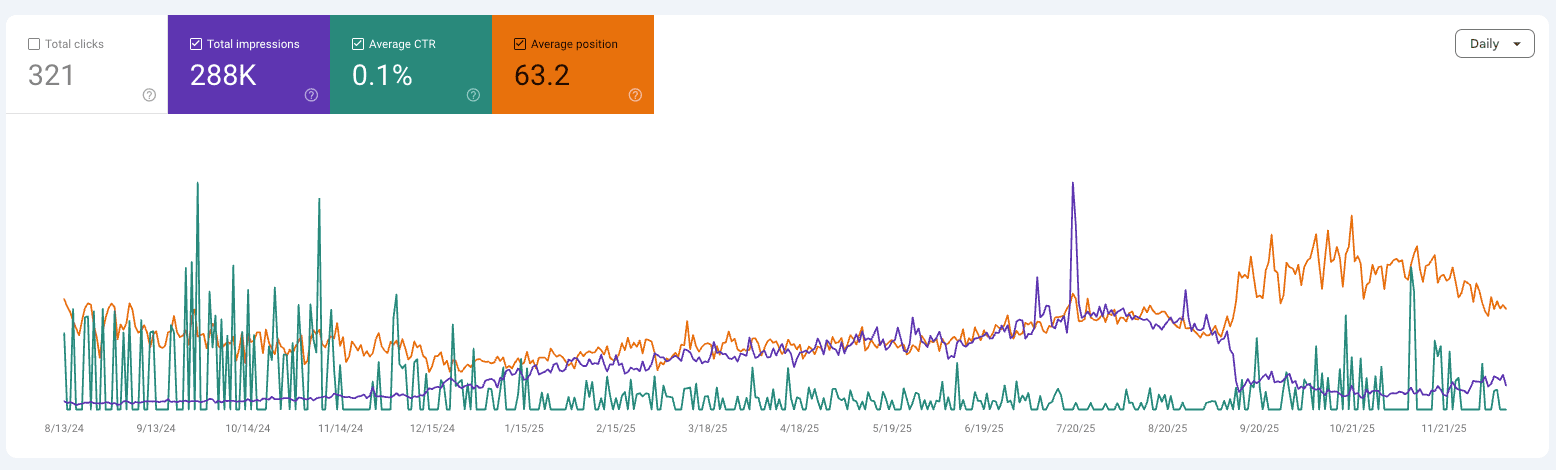
The important thing here is that you can see some characteristics of the average click-through rate and the average position. If you fit the Google Core Update dates on this timeline, you can draw your own conclusions. What do you think? What's happened here?
How much do you think internal linking accounts for this?
The AI Content Problem
I see many sites overusing AI to generate content, and it's reflected in the diagrams I use for analysis. There are article clusters where articles are more than 90% similar—those are certainly AI-generated.
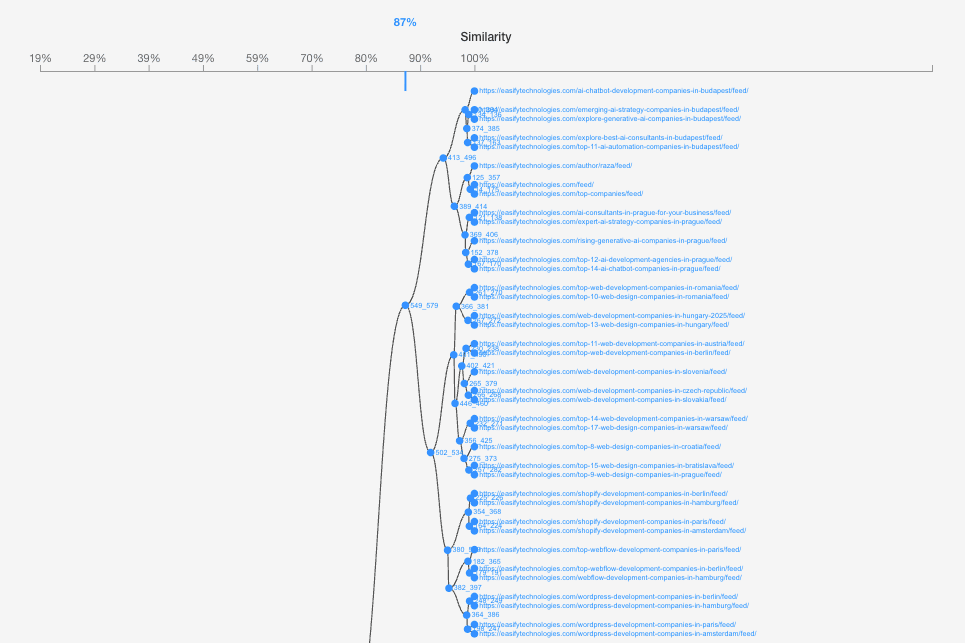
I believe in order to build long-lasting traffic, we need more depth when writing articles, with different angles, tone style that still can fit into the same topic. The example above shows the characteristics of a programmatic SEO or an aggregator site I found during my research.
Moving Forward
So, in summary: my IT agency's website hasn't been updated for a while and went through the Google Core Updates. We only got a couple of backlinks during that time. The Search Console charts show some characteristics that I'm satisfied with.
I'll continue to study how all this information comes together and shapes the future of search intelligence to improve Lexunit's blog.
Understand Your Content Architecture
Want to see how your articles cluster together and identify potential AI-content patterns? OtherSEO's similarity analysis shows you exactly how your content relates—and where opportunities for improvement lie.
What you get:
- Visual similarity clustering of your content
- AI-content pattern detection
- Internal linking opportunities
- Topic coverage analysis